Over the Liffey
Reply
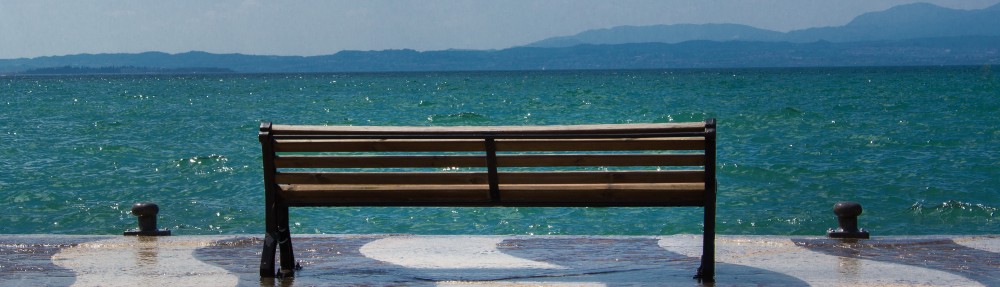


St. Stephen’s Green, a set on Flickr.
At the end of the second week of a photography course I’m taking, I took my trusty Canon 60D out and about in the vicinity of St. Stephen’s Green in Dublin. These were the results.
“I would have had no interest or knowledge of anything associated with disability up until then,” I’m told matter-of-factly over the phone. If Dubliner Stephen Cluskey hadn’t gone to work on that fateful day 10 years ago, he probably still wouldn’t. But he did.
At 18, Stephen had just entered his Leaving Cert year. The set of exams undertaken by those on the cusp of adulthood and independence are often looked back on with overwhelming relief by all who have sat them. While Stephen’s Leaving Cert also signified his transition into adulthood, independence was not to accompany it.
By the time June of 2002 had arrived, he was part-way into a 16-month stay at Dun Laoghaire Rehabilitation Clinic, the result of a farming accident which had left him with a broken neck and a forever altered future. In the decade that has followed, not a lot has changed for him medically. But that’s only half the story.
The hourly, never mind daily obstacles he has faced have made the easy, pre-2002 tasks immeasurably harder. His business mind, sharpened by the distance-learning business degree that he has been taking for the last 3 years, is helping him to view these obstacles as something completely different – business opportunities.
Having travelled to America and Portugal over the years for treatment, what should have been a non-issue soon became an unwelcome distraction. “I really struggled with public transport over there,” he says. Things were very different when Stephen had travelled to London for similar treatment. “In London, every taxi is wheelchair accessible, which I think is something we should be working towards,” he says.
While the latest grant scheme for wheelchair accessible taxis by the National Transport Authority (NTA) may increase the numbers somewhat (see below for more), the numbers are still far too low in Stephen’s eyes. “It’s not going to make a huge impact by any stretch of the imagination,” he says. Far bigger a problem, however, is finding one of these taxis when you need it.
Take Co. Tipperary, for example. As of the 31st of January 2012, figures from the NTA show that only 4 out of 267 taxis and hackneys were wheelchair accessible – less than 2%. To put in another way, someone who is wheelchair-bound and who finds themselves in Tipperary has a less than 1 in 50 chance of getting a public service vehicle that can actually take them where they want to do.
Something needs to be done, and Stephen is managing to do it. “After a lot of research, I realised I wasn’t the only one suffering from this problem,” he says, when recalling the logistical nightmares which have too often taken the fun out of trips or, worse again, prevented them from happening in the first place.
Launched at the beginning of February, www.wheelchairtaxi.ie is his brainchild. The best ideas are often the simplest ones, with Stephen’s definitely falling into the why didn’t I think of this before category. Offering a way for drivers of wheelchair accessible taxis to register their services through the website has so far led to nearly 70 to date.
Users can then find wheelchair accessible taxis in their locality. Realising that the site is unworkable without suitable taxis, taxi drivers or those looking to use them are not required to pay any fees. Helping to solve a major problem which in turn makes your own life easier in the process doesn’t mean that you can’t turn a profit, however.
Having already spent approximately €1000 on getting the site to where it is today Stephen neither expects charity nor seeks to run one. With a business model in place which he believes will turn a profit, from next month the site will list more types of accessible transport.
Advertisements for wheelchair accessible minibuses, coaches, vans and even boats are planned, with the advertiser paying a fee for access to a niche market. “I plan to make it as much of a one stop shop as possible,” he says. “With the internet nowadays you can search sites for everything, from comparing your insurance to checking out the property market. I suppose it’s just an extension of that for the disabled community.”
Having gotten details from the Taxi Regulator, Stephen has personally sent out text messages via the internet to every taxi driver in the country to alert them of the website. Circumstances may have changed how he interacts with technology, but it has also proved to be the great equaliser for him over the last decade.
Describing our initial contact via email, he tells me how software transformed his words into text, ready to be sent. “A head mouse, which is like a sensor which sits on top of a computer allows me to move my head and the mouse moves with me. To click I hold it in the same position for a second or two,” he tells me, describing the process which has now become second nature to him.
Whether ultimately profitable or not, everything Stephen has done to date has been driven by a very simple premise, which the younger version of himself would never have given a second thought to. “I want to restore that spontaneity back into the lives of people with disabilities so that they don’t have to plan everything.”
They say the best ideas are often the simplest ones. So why didn’t we think of that?
Small Public Service Vehicle (SPSV) licenses as at 31/01/12

On the 1st of February 2012, the National Transport Authority (NTA) launched the second Wheelchair accessible Grant Scheme, which made €165,000 available for the upgrading of licensed vehicles to be wheelchair accessible, along with an additional €85,000 for those wishing to enter the profession. For those looking to upgrade, the payout per recipient is capped at €15,000.
If each recipient were to receive the max payout, this would result in the conversion of only 11 taxis nationally, with funds being split 50:50 between Dublin and the rest of the country.
Speaking to Joanne Coffey, whose PR firm represents the Commission for Taxi Regulation, the first Wheelchair accessible Grant Scheme resulted in 16 new vehicles and 5 conversions. Using the earlier example of Tipperary, however, it only increased its number by 1, from 3 to 4.
How the web could save your life
While ideas such as www.wheelchairtaxi.ie have the ability to improve lives, another initiative is hoping to use technology to potentially save them. Currently being trialled until the end of June, those who are deaf, hard of hearing, or speech-impaired can register their mobile phone number along with other personal information, including any medical conditions, using the website www.112.ie.
In the event of an emergency, a simple text from the registered mobile phone to 112 (the Europe-wide emergency number) will automatically be passed on to An Garda Síochána, the Ambulance service, the Fire service, or the Irish Coastguard. For more information, check out www.112.ie.

Balbriggan harbour, a maritime history kept at arms length
It’s a damp grey day in Balbriggan. Driving through the town my tyres splash through Drogheda and Dublin Street, streets named after the places they’ll take you to, instead of enlightening you as to where you are. The street names remind me of the jaded joke whose punch line asserts that the best feature of a place – a place with people, dreams and a history – is the road, or roads, which leave it. In the five years I’ve lived here I’ve gotten to know some of its people and I know the dreams of many, my wife and mine included, but I know little of its history. The Balbriggan Maritime Museum is trying to change that.
They have given my journey a purpose and my car a destination. The Bracken Court Hotel is hosting a ‘pop-up’ exhibition for one day only, giving a temporary address to a town’s history – a history which finds itself homeless. As I am to learn, Balbriggan has a rich and varied maritime past, made possible by the towns harbour; completed 250 years ago this year.
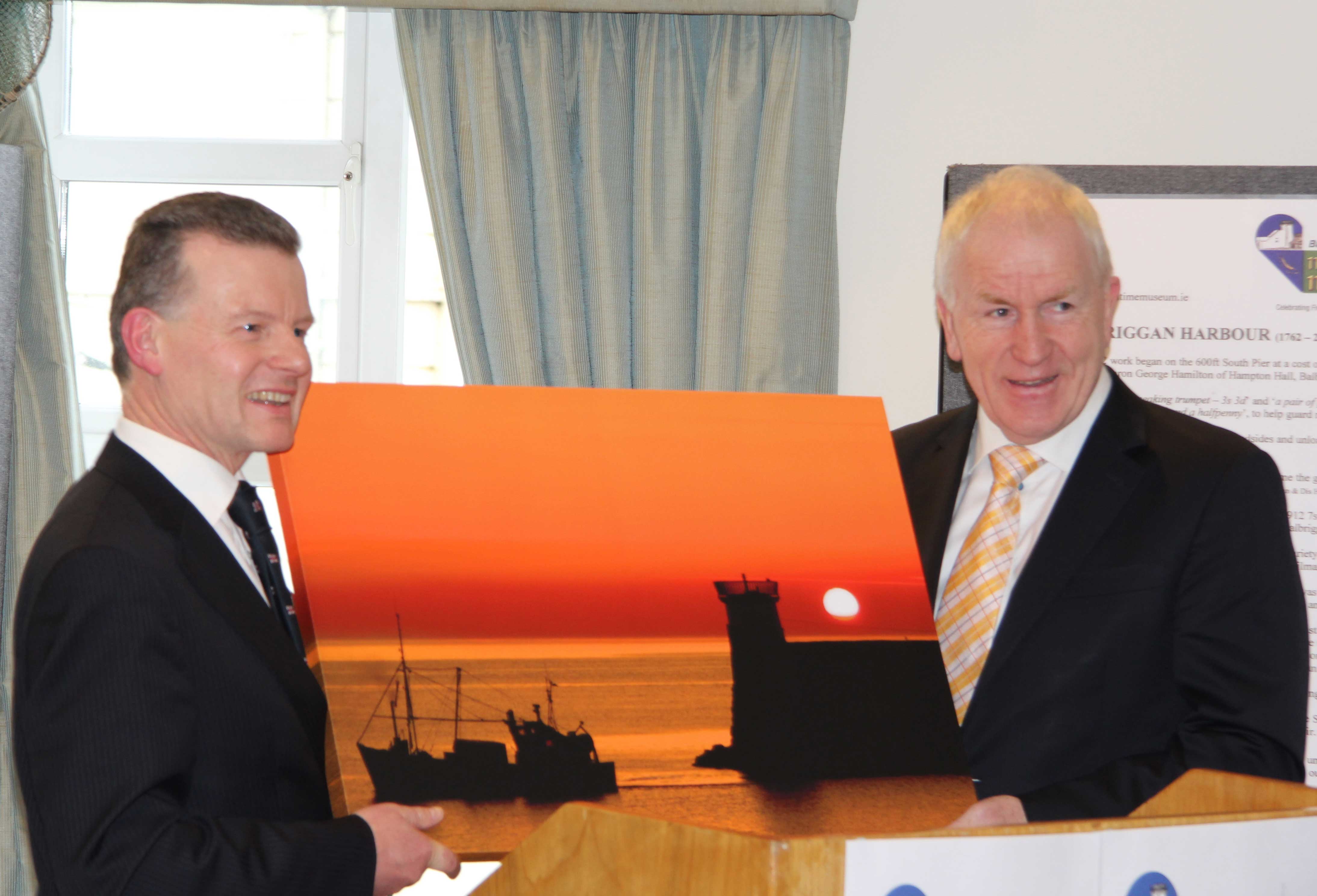
Trevor Sargent and Jimmy Deenihan TD
I arrive to hear ex-TD, Green Party member and Chairman of the Balbriggan Maritime Museum, Trevor Sargent, speak passionately about Balbriggan and its active community, his words filling the already full room. He speaks of his wish for the artefacts on show to have a permanent home in Balbriggan’s former lifeboat house, his speech pleading for ‘this one thing’ time and again. The coup of the day is undoubtedly the attendance of the Minister for Arts, Heritage and Gaeltacht Affairs, Jimmy Deenihan TD, who heralds the ‘pop-up’ museum as ‘a positive beginning’ to the creation of Ireland’s first maritime museum.

Balbriggan’s former lifeboat house - the proposed location for the museum
Once the speeches have ended, the museum is opened for a few short hours. Life and death are on show here for all to see, with recent events both at home and abroad having sadly brought the latter to the fore once again. The rich, detail-laden stories and memorabilia which await me, however, leave no doubt that the Irish Sea, to which the town stares out onto, has given our island nation far more than it has taken.
While the replica boats and unearthed cannonballs on display draw the eye, the dots are joined and the ears informed by the elder statesmen of the town, as they revel in their ability to hold an audience with their knowledge of a smaller town, in a simpler time. It is the strong human element that ties it all together, from the identification certificates of fishermen now long dead, to the slips of laminated card which accompany the items on display, giving the details of those whose private collections now stand liberated before us.

Exhibition replica
There is a lot of history in a quarter-millennium, but its cyclical nature ensures that while the antagonists may change, the same threats re-emerge. In 1777, the United States Ship (USS) Lexington, anchored close by, effectively held Balbriggan to ransom, threatening to turn its guns on the town if fresh water was not provided. All these years later, Balbriggan is once again under threat, but this time the enemies are less visible.
Once one of the fastest growing towns in Ireland, Balbriggan became the bottom rung of the property ladder for many. As one of many who came, my 5-year plan was to prove far from recession proof. Vast estates of duplexes and one-bedroom apartments with little resale value have forever altered the town’s landscape and makeup, leaving it with an unsure identity but an unaltered history.
The once sleepy town may be no more, as the short-term dreams of Balbriggan’s recent residents’ transition into long-term realities, but the wide variety of ethnicities present at the exhibition is proof of a growing, inclusive community. The irony of the town’s single nightclub being called Home may, in time, cease to be so ironic. While the cessation of commercial shipping in the 1960s may have resulted in Balbriggan’s boats no longer reaching the far-flung destinations they once did, the town has now found itself home to citizens from many of those same places.
A single place with the ability to bring all this together has the potential to give rise to the ties that bind, especially in a town with an ever-increasing daily exodus. The recent curtailment of Fás training courses in the town has forced the over 5,000 unemployed to cast their nets further afield. Combined with the employed commuters, vast numbers leave the town each day only to return again during the hours of darkness – the economic fisherman of a modern age.
In a cruel paradox, the growth of Balbriggan has left it with less. Its maritime history, however, remains unaffected and unaltered, with an ability to shine a positive light on the town much brighter than its lighthouse, built by the Hamilton family in 1796, ever could.

Balbriggan lighthouse, built by the Hamilton family in 1796
Balbriggan harbour is a piece of living history, coming into existence at a time when Ireland was still recovering from The Great Famine and America was still a British colony. The changes it has lived through acts as proof that things do end, just as history will one day detail the end of the current recession.
Ireland’s troubled economic climate may continue to leave Balbriggan’s history without a home. Should this transpire, the living accounts of those who have played a major part in it will reach a much smaller audience before vanishing forever, leaving only the artefacts remaining and the dots disjoined.

Balbriggan beach and harbour
In the few short hours that it existed, my visit to the pop-up museum taught me everything that I have now told you. Balbriggan has, up until now, asked for very little and in return lost a lot. The 9th of February 2012 marked the day when the town asked for this one thing. It will be interesting to see what tomorrow’s catch brings.
Spent a few days here on honeymoon.
One of the most beautiful places that you’ll ever see.
Fly-drive holidays may conjure up feelings of a break wasted behind the wheel, but depending on where you find yourself, the experience of travelling from A to B might just change your life, writes Paul Hyland.
HAVING landed in San Francisco, the frantic planning that had underpinned the last 12 months of our lives lay lost in the North Atlantic Ocean, cast adrift by the words “I do”. Our honeymoon was finally here, but upon receiving our rental car, the realisation hit that our driver’s seat was very much over there.
They say time is money, but the scarcity of both had left my bride and I staring nervously at each other in Dublin Airport 12 hours previously. With only our first nights accommodation booked and internal flights deemed an unnecessary frill, a unique driving experience awaited. If the stress became too much, we could always get an annulment anyway. Couldn’t we?
Twelve months later, we find ourselves still very much married, and dare I say it, happy. Equally as happy are the memories of our West Coast adventure. The inconsequential details of the trip may have faded with time, but the standout moments remain as vivid as ever, burned into our collective brains with a seemingly direct link to our endorphin producing pituitary glands.
Our first night in San Francisco was a night of firsts: first time driving in America … at night-time … with a faulty Sat Nav. Yes, it’s fair to say we began to question ourselves – first our logic, and soon after hearing the welcoming car horns, our sanity.
Two days in, and still in one piece (rental car included), we had found our feet. I had gotten used to San Francisco driving, and my wife had gotten used to the idea of spending the rest of her life with me. It’s fair to say we both felt truly at ease for the first time since landing. What better way to test this status quo than with a 300-kilometre drive along California’s Scenic Highway One to Morro Bay?
With roughly 5 hours of driving ahead of me, the thoughts of covering the equivalent of Dublin to Cork, and then some more, brought on a jaw-shattering yawn. Five hours later, I couldn’t have cared less about either county. The mesmerising meandering of the Big Sur had left me both mentally tired and stimulated at the same time.
The Pacific Ocean, with an expanse larger than all of the Earth’s land area combined, had proved itself to be the warmest of companions. Hugging the cliffs, our cars embrace left us with little more than ocean and horizon to fill our peripheral vision; providing views which not only confirmed that we were further from home than ever before, but also made us question whether we were still on the same planet.
Arriving at our destination, we wanted to do it all over again. Our lack of planning had serendipitously provided an experience which each of use will take to our grave. I’d like to think that heaven exists, and if it does, I think I know what it feels like.
Struggling to keep up with the never ending stream of information coming your way via social media? Fear not, you are not alone. That was the reassuring message from Mark Little of Storyful.com when he addressed the recent Dalkey Book Festival. As someone currently studying journalism and who works in IT, Little’s views on how IT and social media are changing the face of news are of particular importance to me.
The former RTE presenter – sitting astride a stool like a country and western singer who has forgotten his guitar – is evangelising to the 40 or so attendees who have congregated in the upstairs in Ouzo’s bar and grill on Dalkey’s Church Street. Now a self proclaimed social media “evangelist”, he believes he has seen the future of journalism and storytelling, a future in which we can all play a part. In the world of social media, he says, reporters will be replaced by witnesses and communities.
Powerbases will no longer be defined by whose job description reads “journalist”, but by who is closest to the action. The observer’s location, whether by choice or chance, is what will give them the scoop, enabling them to become a leader within the social conversation. These citizen journalists are the authentic leaders of such world events as the recent “Arab Spring”.
While the recent rioting in Vancouver was widely reported by both social and traditional media, it was through Facebook pages that people organised a large scale clean up of the destruction, as well as a place to post pictures of the rioters. For those afraid to take the next step, Little says – “dive in, the waters lovely, and it’s not that deep”.
As the big hitters that are Facebook and Twitter continue to grow, it is easy to curse social media for polluting our lives. In fact, the “always on” nature of the web and social media can leave consumers feeling overwhelmed. The Urban Dictionary defines this feeling best with the acronym FOMO – Fear of Missing Out. Whereas journalism and news organisations were once plagued by a scarcity of information, social media has turned this on its head.
The current buzzword in social media is curation, a process which Little defines as consisting of three steps: discovery, verification, and delivery. Verification can prove particularly tricky. An obvious downside to anyone and everyone being able to enter the social conversation is that people can tell untruths, either deliberately or by mistake. There is little use picking out what you believe to be the truth if it cannot be verified. With upwards of 110 million tweets sent per day and 48 hours of video uploaded to YouTube every minute, those with a genuine FOMO face an impossible task.
Little is aware of the turn offs faced by those who wish to embrace social media, realising that 99.9% of what it out there is “basically people talking about what they had for breakfast”, he says. The 0.1%, however, is a more authentic form of reporting than ever before. While some journalists will fear the democratisation of news gathering, Little believes that those who love the form will revel in the open communication within these online communities, where the aloofness and status once afforded to those with a press pass is consigned to an out of date, offline world.
Harking back to his time presenting Prime Time, Little welcomes this shift, believing that there is “something fantastic about being challenged by a bigger community of people”.
Storyful has put Ireland at the heart of making this influx of information useful. As a result of its curation process, the venture is succeeding, and succeeding globally, with YouTube’s news department, broadcast on its CitizenTube channel, being curated by them. I wonder whether our long and proud history of Sean Nós storytelling has the ability to put Ireland on a world stage once again. Just as our Defence Forces are known far and wide for their peace keeping abilities, I believe that Ireland has the potential to become the peace keepers of social media, with Storyful merely the tip of the iceberg.
Asked the question of whether social media cheapens tradition journalism, he believes that “journalists never earned any money from writing” but instead earned it from classified advertising. “The content was never a commodity that could be sold”, he believes. Having worked in what can be classed as traditional journalism for many years, and while understanding their worry, he believes that “journalists have to get over themselves” and must realise that “we only ever have use if we have value”.
News content, he believes, needs to be free, but what the 140 character snippets coming from Twitter will never do adequately, is to provide the necessary context. This is where the print media will continue to have a part to play. Damningly, he believes that “there is way too much talk about saving newspapers. I don’t want to save newspapers; I do want to save journalism”. “How people consume is of no interest to me as long as we are getting quality and authenticity”, he says.
Responding to my point about what I deemed to be a watershed moment recently with the announcement that The Guardian News and Media was to become a digital-first organisation, Little replied that steps such as this are “the responsibility of the leaders, the managers” of print media.
Caution is required, however, to ensure to not destroy the advertising revenue generated from the print edition, and, indeed, its sales. That said, when he says he refuses to “pay for a newspaper to tell me what I found out on Twitter 3 days ago”, it’s hard not to see his point, and to see the major challenges which lie ahead for Ireland’s traditional media outlets.
As someone who holds a BSC in computing and 7 years experience as a Software Engineer, even I struggle to keep up with the pace at which social media is evolving. For those thinking of stepping away from social media due to the volume of information coming their way, I would say this; do not cut off your nose to spite your face. Let the curators do the work for you. This new world that we find ourselves in is not going to change anytime soon. As the generations that follow come into the world, what we are struggling to get to grips with will be normal to them. If you give up now, you really will be left behind.
For the most part, this social media “evangelist” was preaching to the converted, but I still walked away feeling excited at what this still new platform holds for journalists the world over. Despite the hurdles that the industry currently faces, I found his views inspiring. While Little has for now moved on from the more traditional form of journalism, I believe that both can co-exist. As long as the message can be delivered successfully to those who want or need to get it, the medium remains secondary.
Once home, I wanted to ask if I could quote him for this article. But how could I reach him, having only met him for the first time earlier that evening? Via Twitter of course! And did he respond to his community? I believe this article answers the question.
The main thing which has come out of the Cloyne report is also the least surprising one. As if it needed confirmation, we now know that there is something fundamentally wrong with the concept of reporting abuses perpetrated by members of the Catholic Church to other members of that same church. In an ideal world, where men of the cloth held themselves to the same moral standards that they preach from the pulpit, it shouldn’t make a difference. The findings of the Cloyne report, however, prove that we live in a far from ideal world.
If you were mugged, would you report it to a family member of the accused, in the hope that their moral compass would direct them towards the local Garda station? Of course not. So why should the Catholic Church act as the middle man for such heinous offences?
What is equally as worrying is the apparent inability of state services to communicate with each other. How did alarm bells not sound when 6 of the 15 complaints were reported to the Gardaí and none to the HSE? Simple communication between the 2 bodies could have uncovered this sorry mess years ago.
It is clear to see that there is something very wrong with the Catholic Church. As a practicing Catholic whose religious beliefs have survived intact into adulthood, it’s a sad thing to have to admit. But it’s true, and obvious. Anyone who calls themselves Catholic should have a genuine interest in rescuing their religion instead of continuing to hide its indiscretions, further dragging it into the abyss. And yet the Catholic Church appears happy to do so.
While Pope Benedict may believe that gay marriage poses an “insidious threat” (to exactly whom I am unsure), far more harmful is the churches reluctance to clean up its act. As long as the church fails to practice what it preaches, its numbers will continue to dwindle, and this Catholic will find it harder and harder to remain one of the faithful.


 Paul Hyland